About CAPS
CAPS is a shorthand for Czech-Austrian-Polish-Slovak Match. It is a mathematical competition in the format of the International Mathematical Olympiad (IMO) and serves as a preparation for the IMO teams of the respective countries, with Ukraine as a guest country. Each of these teams contains the most successful students in the national mathematical olympiads.
History
The annual competition CPS (Czech Polish Slovak Match) has a history going back decades. The first edition took place in 1995 with Czechia and Slovakia only; Poland joined from 2001 on. It serves as the final preparation for the students before the IMO.
Starting from 2016, the competition is regularly hosted at ISTA. Austria started to participate in 2017 and consequently joined the organizing countries. In these years, the responsible local organizers were Josef Tkadlec and Michal Rolínek. There was no competition at ISTA in 2020 and 2021 due to the pandemic, but the event took place nevertheless in a virtual mode.
Since 2022, CAPS continues to take place annually at ISTA, including a team from Ukraine as a guest country. The responsible faculty member is Tamás Hausel; the actual local organizers have been Kamil Rychlewicz (Poland), Jakub Löwit (Czechia), Shon Ngo (Ukraine), Lenka Kopfová (Czechia), Daniel Holmes (Austria) and Peter Súkeník (Slovakia) – all PhD students at ISTA.
Format of the competition
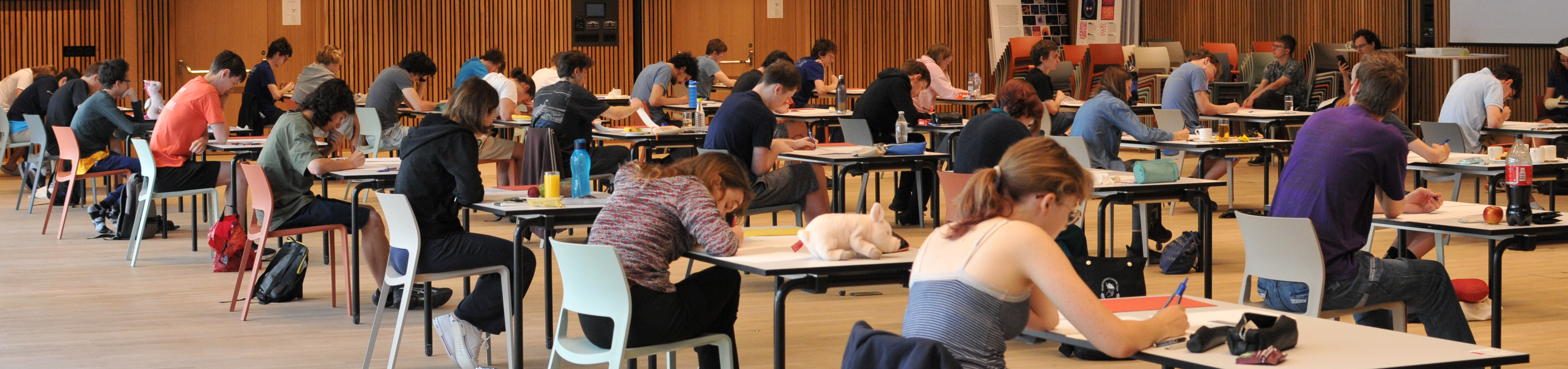
The competition itself follows the format of the IMO. It consists of two separate sessions; on each day the students have 4.5 hours to solve 3 challenging problems. The format of CAPS further requires 2 additional female competitors from each country.
The organization of the competition is done by the local organizers and team leaders with support from the national olympiads: this amounts to preparing the problems, overseeing the competition and organizing the marking process. The marking is coordinated by a jury consisting of additional volunteers from ISTA, usualy PhD students and postdocs. During the award presentation, there is an invited research talk by an ISTA faculty member.